


Light Needs

Mature Height

Mature Spread

Growing Zones
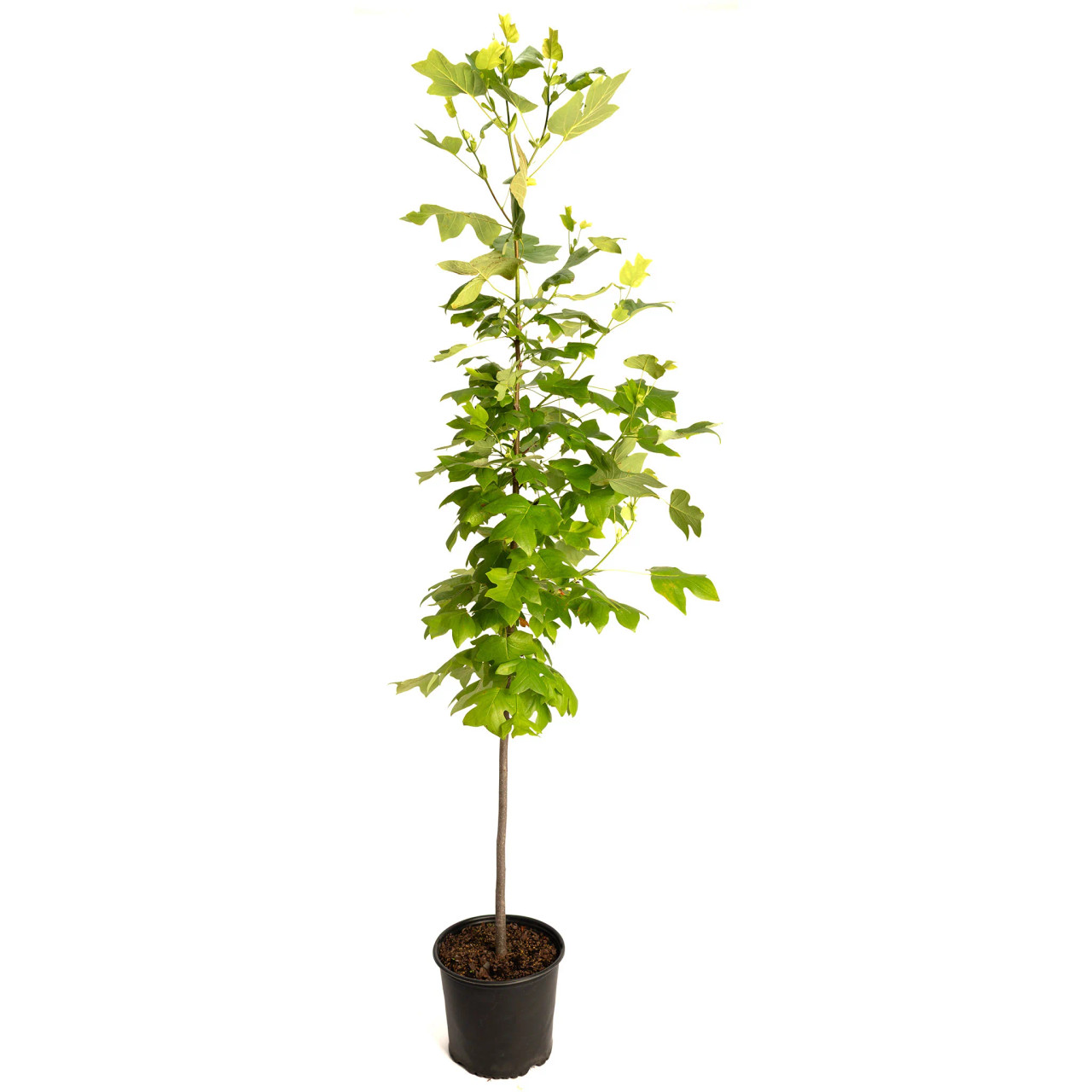
Plant Tulip Poplar (aka Tulip Tree) when you want scale, speed, and a native canopy that establishes sooner than most large shade trees. Liriodendron tulipifera grows into a tall, straight tree with an upright young form. Its unusual four-lobed leaves turn golden in the fall, and spring flowers marked yellow and orange resemble tulips high in the branches. The biggest draw is how quickly it becomes a useful shade tree for large properties. We recommend it for open ground where a long-lived native tree would make good use of the space.
This deciduous member of the magnolia family is native to eastern North America. It has a strong wildlife role, with nectar-rich blooms that draw hummingbirds and pollinators and seeds that feed birds and small mammals. It is highly effective in naturalized borders, meadow edges, and broad lawns where its tall trunk and high canopy can develop properly. The flowers can be easy to miss from a distance on mature trees, so the leaf shape, stately outline, and fall color carry much of the landscape value. Give it room and it becomes a landmark tree rather than just another shade planting.
Tulip Poplar Care
Plant Tulip Poplar in full sun in deep, fertile, well-drained soil with an acidic pH for the strongest growth. It can handle some partial shade and shows tolerance for clay and occasional wet soil, but it is happiest in organically rich ground that does not stay compacted or dry for long. This is not the tree for shallow, droughty sites.
Water deeply and regularly while the tree establishes, and continue during extended dry periods, especially if interior leaves begin to yellow and drop in summer. Fertilizer is usually not needed in good soil, although young trees in lean ground can benefit from a light spring feeding. Tulip Poplar drops its leaves in fall and goes dormant for winter, with cone-like seed clusters often lingering after the foliage is gone.
Prune only as needed to remove damaged, crowded, or poorly spaced branches while the tree is young, since heavy cutting can leave large wounds on a fast-growing tree. Structural pruning is best done in late winter or very early spring before growth starts. Keep the root zone mulched and protected from mower traffic, because shallow surface roots can become an issue as the tree matures.
Tulip Poplar Spacing
Give Tulip Poplar at least 30 to 40 feet from buildings and other large trees, with more room if you want the crown to spread naturally over time. It is not a container tree beyond the nursery stage, so give it a permanent planting site. In the landscape, pair it with Joe Pye weed, asters, and viburnum for a loose native-style planting that supports pollinators around the base. Near newer plantings or adjacent beds, use pansies and lobelia for early seasonal color while the tree is still young and the surrounding space is filling in.
Simple Plant Spacing Calculator

Please Note: The pictures below are to give a general representation of the different container sizes. The actual size/ages of plants are estimates and will vary based on type of plant, time of year, last pruning & many other factors.
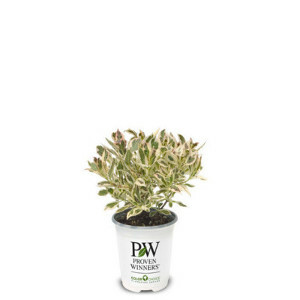
Also Known As:
Quart
Plant Age:
~ 6 months - 1 year
Plant Size:
~ 4"-8"
Pot Size:
~ 4.75"H x 4.5"W
Volume:
1.50 quarts
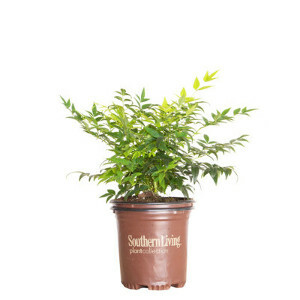
Also Known As:
2.5 Quart Pot
Plant Age:
~ 1 - 2 years old
Plant Size:
~ 8"-12"
Pot Size:
~ 6.5"H x 6.5"W
Volume:
2.20-2.30 quarts
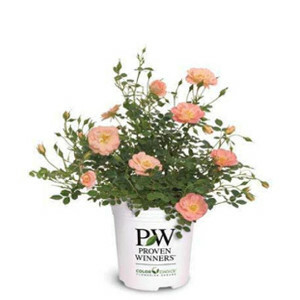
Also Known As:
#1 Container
1 Gallon
Plant Age:
~ 1 - 2 years old
Plant Size:
~ 10"-14"
Pot Size:
~ 7"H x 7.75"W
Volume:
2.26-3.73 quarts
Also Known As:
#2 Container
2 Gallon
Plant Age:
~ 1.5 - 3 years old
Plant Size:
~ 12"-18"
Pot Size:
~ 9.5"H x 9.5"W
Volume:
1.19-1.76 gallons
Also Known As:
#3 Container
3 Gallon
Plant Age:
~ 2 - 4 years old
Plant Size:
~ 12"-30"
Pot Size:
~9.5"H x 11"W
Volume:
2.32-2.76 gallons

Also Known As:
#5 Container
5 Gallon
Plant Age:
~3-4 years old
Plant Size:
~ 20" - 60"
Pot Size:
~11" H x 10 1/2” W
Volume:
3.5 - 4 gallons

We stand behind our plants with industry-leading guarantees to give you peace of mind.
We want your plants to arrive in great condition! If you notice any issues upon delivery, contact us within 3 days.
Starting January 1, 2026 all bushes, perennials & trees purchased come with an extended 1-year warranty for added confidence. If your plant dies due to a health issue within a year, we’ll make it right.

Pre-ordered plants are scheduled to ship in Spring 2026. We carefully plan our shipping dates based on your USDA Plant Hardiness Zone to ensure optimal planting conditions upon arrival. Want it sooner/later? Reach out, and we'll try our best to accommodate.
Estimated ship week for pre-ordered plants will ship based on growing zones as shown below.
| Growing Zone | Estimated Ship Week |
|---|---|
| Zone 10 | March 30th |
| Zone 9 | March 30th |
| Zone 8 | April 6th |
| Zone 7 | April 13th |
| Zone 6b | April 20st |
| Zone 6a | April 27th |
| Zone 5b | May 4th |
| Zone 5a | May 11th |
| Zone 4 | May 18th |
| Zone 3 | May 25th |
Note: These are only estimated ship dates. Plants may ship out later depending on weather & growing conditions of the plant.
Note: Only plants indicated as pre-order will ship as shown above. All other plants and hard goods will ship as normal.
Plants that are currently in stock typically ship within 2-7 business days after your order is placed.
Plant Addicts ships to the lower 48 states within the U.S. Unfortunately, we do not currently ship to Alaska, Hawaii, or internationally.
This plant cannot be shipped to the following states: AZ, CA, ID, WA, OR, AK, HI. These restrictions apply only to this specific plant due to agricultural regulations or other limitations. Other plants may still be available for shipping to these states.
If you have any questions about shipping restrictions, feel free to reach out to our team!