
Everlast™ Dianthus 1 to 6 of 6 total


Everlast™ Dianthus 1 to 6 of 6 total
Chat/Email Support
Mon-Thur, 7 AM - 6 PM CST
Fri, 7 AM - 5 PM CST
Sat-Sun, 9 AM - 3 PM CST
Chat Us Email Usinfo@plantaddicts.com
Phone Support
Mon-Fri, 8 AM to 5 PM CST
Everlast™ Dianthus was bred for a long display: an early spring flush, steady color into summer, and a fresh wave of flowers as nights cool in late summer. Compact 8–12″ mounds of blue-green foliage provide the backdrop for spicy, clove-scented single and double flowers, sized for border fronts, rock gardens, walkway edges, and patio pots.
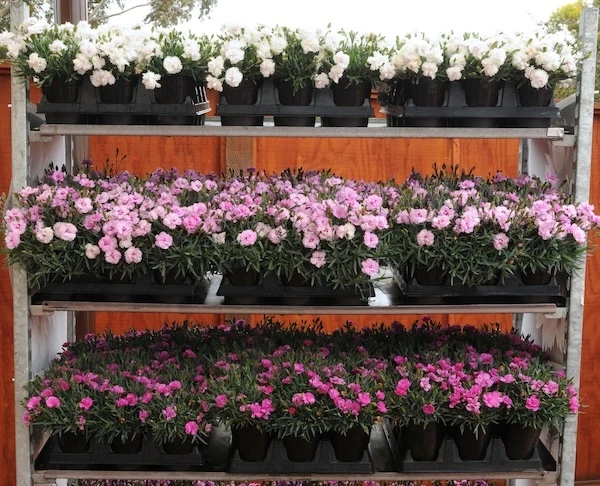 Everlast™ Dianthus Series
Many garden pinks put on one big show in late spring, then go quiet once summer heat arrives. Everlast™ was bred to stretch that show out. Plants flower early in spring, keep producing into summer, and return with a fresh flush as nights cool in late summer and fall. Each plant forms a tidy mound of fine blue-green foliage topped with spicy, clove-scented flowers, in a size that suits border fronts, rock gardens, walkway edges, and patio containers.
Expect a heavy spring flush, steady bloom into summer, and a second wave in late summer and fall. The breeder says Everlast™ displays more days of color than any other perennial dianthus it offers.
Pinks are known for their spicy, clove-like fragrance, and Everlast™ is rated very fragrant. Plant it beside a step, gate, patio, or path where you walk past it every day.
The narrow blue-green leaves stay attractive through most winters, plants handle rough weather well, and rabbits and deer usually leave them alone.
Everlast™ looks like a classic cottage-garden pink, but it carries a surprising mix of plant families and more than a decade of selection work.
Everlast™ is an interspecific dianthus, combining more than one Dianthus species. Violet Blue, for example, is a cross of florist’s carnation (Dianthus caryophyllus) for larger, ruffled, fragrant flowers and the cheddar pink (D. gratianopolitanus) for cold hardiness and a low cushion of blue-gray foliage.
The series comes from Klemm + Sohn, the Stuttgart, Germany company behind the Selecta brand. Every variety is grown from cuttings rather than seed, so each plant matches the original selection in color, flower form, and habit.
Selecta’s Everlast™ collection includes both single and double flowers. Singles such as Violet Blue have five fringed petals and a distinct eye. Doubles such as Orchid and Burgundy Blush layer their fringed petals and look like miniature carnations.
All six share the same compact size, fragrance, and repeat-blooming habit. What sets them apart is color, flower form, and the planting partners they pair best with.
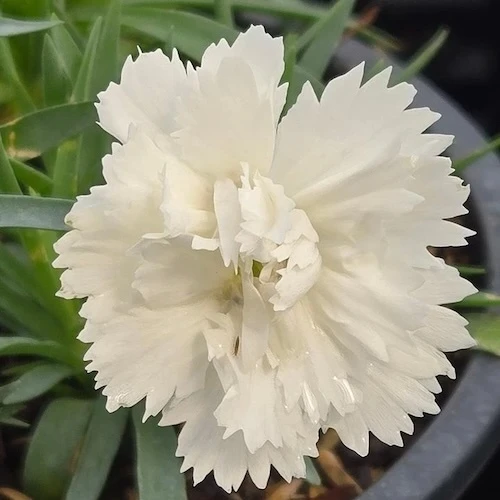
Clean, pure white ruffled flowers
What sets it apart: The only all-white flower in the lineup, with no colored eye. It is the easiest Everlast™ to mix with other colors and the one that shows up best at dusk, when the fragrance is often strongest.
Try it with: Blue salvia, catmint, coneflower, or sedum, or as a calming break between brighter Everlast™ colors.
Shop Everlast™ White →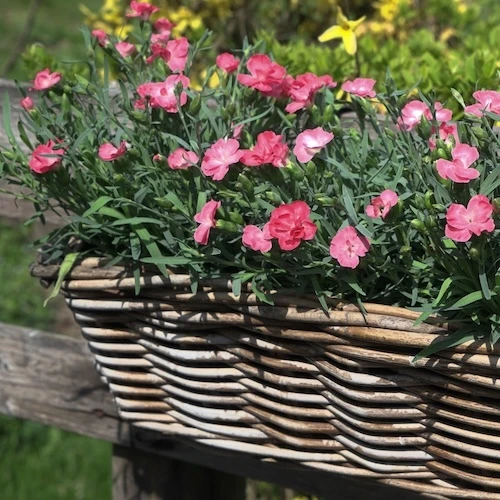
Salmon-peach doubles that shift tone with light
What sets it apart: The newest genetics in the group and an unusually warm color for a perennial pink. Flowers can read deeper peach in strong sun and softer coral-pink in lower light.
Try it with: Blue or purple annuals such as Osteospermum, blue fescue, or coral bells in caramel and amber tones.
Shop Everlast™ Peach →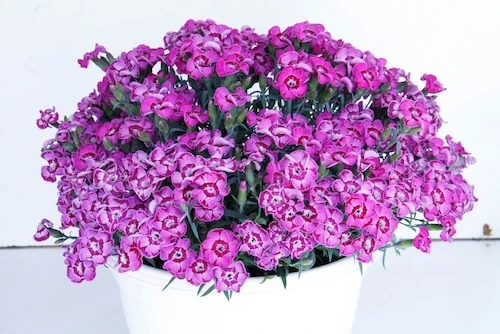
Violet to lavender-blue with a dab of magenta at the center
What sets it apart: The closest Everlast™ gets to blue. Its single flowers show off a crisp, darker eye, developed from a carnation × cheddar pink cross.
Try it with: Yellow coreopsis or blanket flower for contrast, or silver foliage plants for a cool palette.
Shop Everlast™ Violet Blue →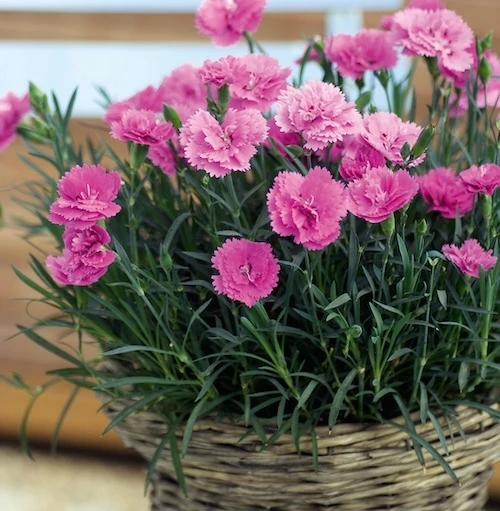
Bright bubble-gum to rose-pink frilly doubles
What sets it apart: The classic “pinks” look, with full, fringed double flowers held just above the foliage. Short stems make charming bud-vase bouquets, and cutting them encourages more buds.
Try it with: Yellow blanket flower, bugleweed spilling over a pot rim, or Everlast™ White.
Shop Everlast™ Orchid →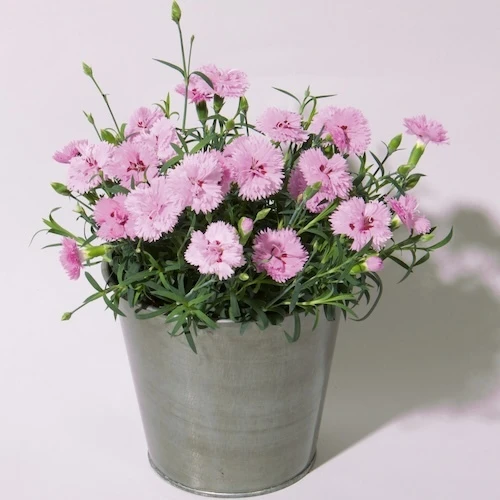
Fringed lavender-pink doubles with a deeper eye
What sets it apart: One of the original Everlast™ varieties and the softest bicolor in the group. The darker center adds depth.
Try it with: Smoky-leaved sedum and blue scabiosa, or soft rose yarrow, as in the trial containers below.
Shop Everlast™ Lavender + Eye →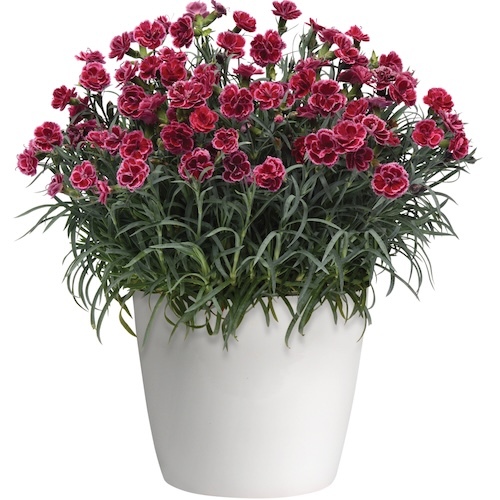
Velvety burgundy-red with a fringed pink edge
What sets it apart: The darkest color in the lineup. It is known for compact growth and early flowering, making it a strong choice for small pots and the very front of a border.
Try it with: Silver-leaved lamium, chocolate-toned sedum, and yellow blanket flower for high contrast.
Shop Everlast™ Burgundy Blush →| Variety | Flower Form | Color | Best For |
|---|---|---|---|
| White | Ruffled | Pure white | Mixing with any color, evening gardens |
| Peach | Double | Salmon-peach, shifts with light | Warm schemes with coral, orange, or blue |
| Violet Blue | Single | Violet to lavender-blue, magenta center | Cool palettes and contrast with yellow |
| Orchid | Double, fringed | Bright rose-pink | Classic cottage look, small bouquets |
| Lavender + Eye | Double, fringed | Lavender-pink with darker eye | Soft pastel borders and containers |
| Burgundy Blush | Double, fringed | Burgundy-red with pink edge | Small pots, high-contrast plantings |
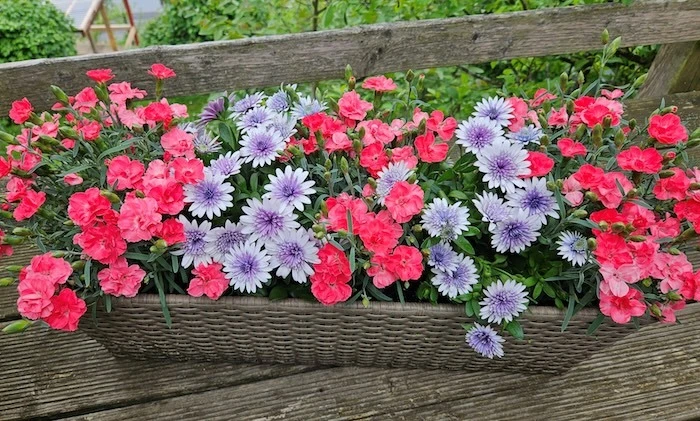
Everlast™ flowers early and tolerates frost, so it can share a basket with other cool-season bloomers. Here, Peach’s warm salmon flowers sit beside the cool tones of Osteospermum 4D Blue Ice for an early-spring porch display.
When the annuals fade in summer heat, transplant the dianthus into the garden, where it will flower again in fall and return next spring.
These mixed perennial containers were grown at the Darwin Perennials trial grounds in West Chicago, Illinois. Each pairs Everlast™ with perennials that share its love of sun and sharp drainage.
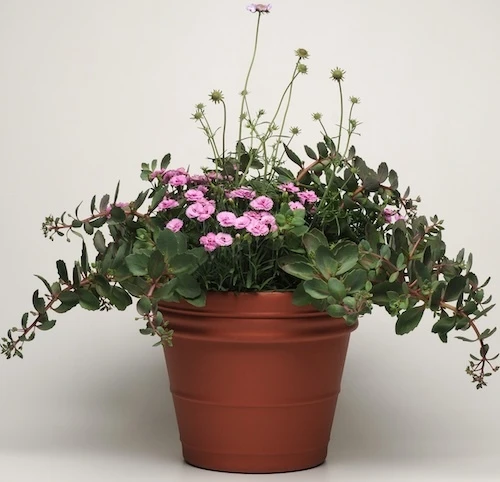
Smoky purple sedum foliage and blue pincushion flowers build a soft pastel palette around the lavender-pink dianthus.
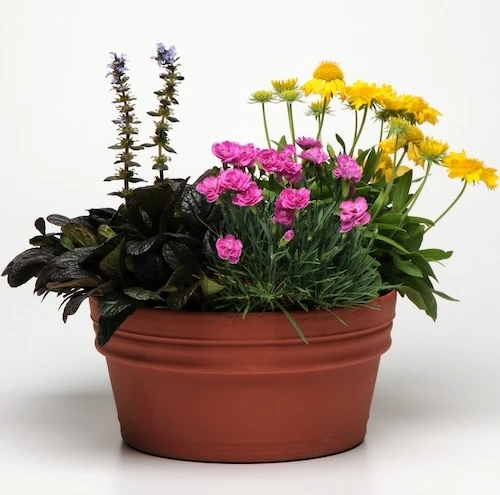
Hot pink and sunny yellow make a cheerful contrast, while bugleweed fills the base and softens the pot’s edge.

Variegated lamium and chocolate sedum echo the dianthus’s dark center, and yellow gaillardia makes the burgundy pop.

Rose-toned yarrow adds height and long summer color, while gold-edged foliage brightens the arrangement after the first dianthus flush.
Filmed at the Selecta One booth during Darwin Perennial Days in West Chicago, this short video introduces the breeder’s perennial dianthus lineup.
Look for the silvery foliage and the mix of single and double flowers that define Everlast™, along with its breeder hardiness rating of Zone 5a.
Everlast™ is low maintenance, but dianthus has a few clear preferences. Get sun and drainage right and most of the work is done.
Aim for at least 6 hours of direct sun. Plants tolerate part sun but flower less. In the hottest climates, light afternoon shade helps.
Choose loose, well-drained soil with a neutral to slightly alkaline pH. Lighten heavy clay with compost and grit, or plant on a slope, raised bed, or rock garden. If a soil test shows an acidic pH, add garden lime.
Set plants at the same depth they grew in the pot, never deeper, and space them 12–14 inches apart. Keep bark mulch pulled back from the crown; a thin gravel mulch is ideal.
Water new plantings regularly for the first few weeks. Once established, soak the soil and let the top few inches dry before watering again. Pots dry faster, so check them often in summer.
Feed regularly for the best display, using a balanced slow-release fertilizer in spring. In containers, add a bloom-promoting liquid feed every few weeks while plants are flowering.
Snip faded flower stems back to the leafy cushion. Leave the blue-green foliage in place, as it protects the crown and stays attractive into winter.
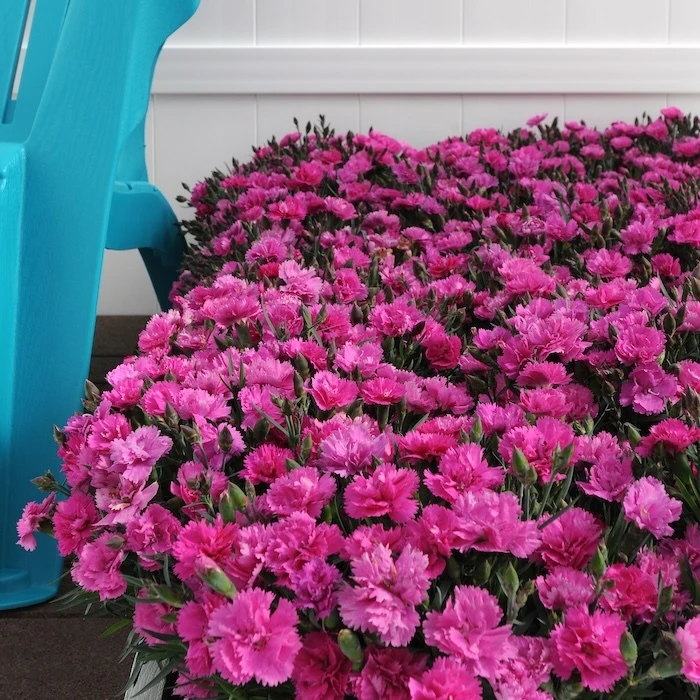
Trim off any leaves damaged over winter and apply a light slow-release fertilizer. Everlast™ is one of the earliest perennials to flower.
This is peak bloom. Deadhead weekly, or cut stems for vases, to keep new buds forming.
Flowering slows during the hottest weeks. Clip spent stems, keep containers watered, and continue light feeding so plants are ready to rebloom.
Cooler nights trigger a fresh wave of flowers that can last until hard frost. Stop fertilizing by late summer and leave the foliage standing for winter.
Start with full sun and well-drained soil, then deadhead regularly by snipping spent flower stems back to the foliage. Feed lightly through the growing season and water deeply during dry spells, especially in containers.
Even with good care, most dianthus slow down during the hottest weeks of summer. Everlast™ was bred to push through that slump and rebloom strongly once nights cool, so keep up deadheading and watering in midsummer to set up the fall flush.
Avoid neighbors that shade or smother low mounds, such as large, floppy perennials and fast-creeping groundcovers that grow over the crown. Skip plants that need constantly moist, rich soil, like hostas, astilbe, and ferns, because the extra water can rot dianthus.
Acid-loving shrubs such as azaleas, rhododendrons, and blueberries are also a poor match, since dianthus prefers neutral to slightly alkaline soil. Good partners include lavender, catmint, sedum, salvia, coreopsis, blanket flower, and other sun lovers that like sharp drainage.
Garden pinks are often described as short-lived perennials, and most perform best for roughly three to five years. Good drainage, especially in winter, is the biggest factor in a long life.
When the center of a clump starts to thin or flowering declines, divide it in spring and replant the healthiest outer sections. That renews the planting for several more seasons.
No. Everlast™ forms a tidy mound that slowly widens to about 10–14 inches. It does not run underground or take over a bed. Because each variety is grown from cuttings, any stray seedlings that appear will not match the parent plant.
Remove spent flower stems, but leave the foliage cushion in place over winter. The leaves stay blue-green in all but the coldest winters and help protect the crown. In early spring, trim away any brown or damaged foliage before new growth begins.
It is a perennial, rated by the breeder as hardy to Zone 5a. Because it flowers heavily in its first year, it can also be used like an annual in spring containers and then planted out into the garden. Check each product page for the growing zones listed for that variety.
Both belong to the genus Dianthus. Carnations are typically taller plants with larger flowers grown for cutting, while “pinks” are shorter garden plants with smaller, often fringed flowers. The name “pinks” is usually traced to the fringed, zigzag petal edges, the same idea behind pinking shears, rather than the flower color.
Everlast™ sits in between: it combines carnation-type flowers and fragrance with the compact habit and hardiness of a garden pink.
Yes. Use a pot at least 12 inches wide with drainage holes and a gritty, well-drained potting mix. Roots in containers are more exposed to cold than roots in the ground, so in colder zones move the pot to an unheated garage or shed for winter, or plant it into the garden in fall. Keep the soil barely moist, never soggy, while plants are dormant.
Wet soil is the most common cause. Dianthus can handle cold, but crowns rot when water sits around them through winter and early spring. Heavy clay, low spots, thick mulch piled against the plant, and planting too deeply all raise the risk. Improve drainage or move plants to a raised or sloped spot.
Dianthus is generally considered resistant to both. The fine, gray-green foliage is rarely a first choice for browsing animals. No plant is completely deer-proof, though, and hungry animals may still sample new plantings.
The ASPCA lists carnation (Dianthus caryophyllus) as toxic to dogs, cats, and horses. Chewing the plant usually causes mild stomach upset and skin irritation. Keep plants out of reach of pets that like to nibble, and contact your veterinarian if you have concerns.
Choose from white, peach, violet blue, orchid pink, lavender bicolor, and burgundy Everlast™ Dianthus for border fronts, rock gardens, walkways, and patio containers.
Shop Everlast™ Dianthus →