
Hardy Hibiscus 1 to 40 of 40 total




Hardy Hibiscus 1 to 40 of 40 total
Chat/Email Support
Mon-Thur, 7 AM - 6 PM CST
Fri, 7 AM - 5 PM CST
Sat-Sun, 9 AM - 3 PM CST
Chat Us Email Usinfo@plantaddicts.com
Phone Support
Mon-Fri, 8 AM to 5 PM CST

Mostly Zones 4–9

Full Sun For Best Bloom

Consistent Moisture

Flowers Up To 9 Inches
Hardy hibiscus are perennial rose mallows bred from cold-hardy Hibiscus species and hybrids. By summer, an established plant can look like a substantial flowering shrub, but it does not keep a woody framework through winter. Frost kills the stems, the crown rests below ground, and new shoots return in late spring. Once growth starts, hardy hibiscus fills out quickly and flowers from midsummer into early fall.
Hardy hibiscus can be slow to emerge in spring. Do not assume the plant has died when nearby perennials are already growing. Many rose mallows are among the last plants to break dormancy.
Dinner plate hibiscus is an informal name for hardy perennial hibiscus with exceptionally large, rounded flowers, often about 7–9 inches across. It is not a separate hibiscus species. The name is commonly applied to rose mallow and Hibiscus moscheutos hybrids whose flowers approach the size of a dinner plate.
The individual blooms are short-lived, often lasting only a day, but established plants form many buds and open new flowers in succession. Newer breeding has also produced cultivars that carry buds along more of the stem, extending the overall flower display.
All three are sold as hibiscus, but their winter behavior, flower size, and landscape use are very different.
| Type | Plant Habit | Typical Flowers | Typical Zones | What Happens In Winter? |
|---|---|---|---|---|
| Hardy Hibiscus / Rose Mallow | Herbaceous perennial with a shrub-like summer habit | Very large, commonly 6–9 inches | Mostly 4–9 | Top growth dies back; new stems rise from the crown in spring. |
| Rose Of Sharon | Deciduous woody shrub | Usually smaller than rose mallow flowers | Mostly 5–9 | Woody stems remain and leaf out again in spring. |
| Tropical Hibiscus | Frost-tender evergreen shrub in warm climates | Large tropical flowers, commonly 4–6 inches | Mostly 9–11 outdoors | Cannot tolerate the winter cold that hardy hibiscus survives. |
See all three groups in our Hibiscus collection.
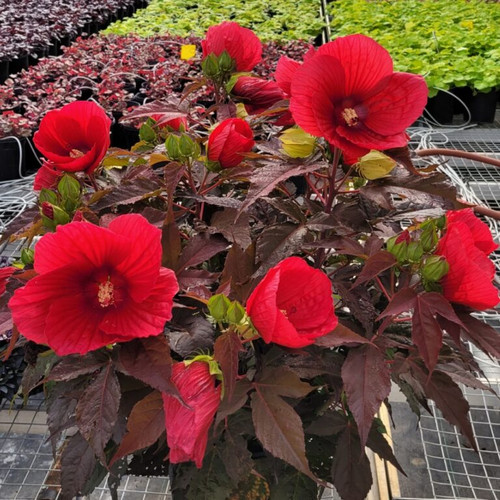
Hardy hibiscus comes in red, pink, rose, blush, white, and bicolor combinations, often with a contrasting eye. Choose color after confirming growing zone and mature size.
Green foliage gives a classic rose mallow look. Dark-leaved cultivars such as Midnight Marvel and several Summerific selections add burgundy, purple, or near-black foliage before flowering begins.
Compact varieties may stay near 3 feet tall, while larger rose mallows can reach 4–6 feet or more. Allow enough width so neighboring perennials are not crowded by midsummer.
Some cultivars flower mainly toward the stem tips. Others set buds farther down the stems, creating more flowering points and a longer overall display.
Many hardy hibiscus hybrids trace to wetland species. They are strong choices for moist borders, pond edges, and rain-garden conditions when the site also receives enough sun.
Use a single plant as a summer focal point, repeat several through a perennial border, place them near water, or grow compact selections in large containers.
Large scarlet-red flowers contrast with deep wine-purple foliage on a compact plant around 3–4 feet tall.
A compact hardy hibiscus with large pale flowers, red centers, and dark purple-black foliage.
A newer hardy selection for sunny, evenly moist gardens with a full summer habit and large flowers.
A moisture-loving hardy hibiscus suited to borders, large planters, and pond-side focal points.
A compact rose mallow around 3 feet tall with broad red flowers and a mounded habit.
A multi-variety option featuring large-flowered hardy hibiscus for sunny summer plantings.
Full sun produces the strongest stems and heaviest flowering. Light shade is tolerated by many cultivars, but plants may bloom less and dark foliage may develop more green tones.
Hardy hibiscus prefers rich soil that stays consistently moist. Do not let established plants repeatedly wilt during active growth; drought stress can cause lower-leaf loss, bud drop, or leaf scorch. Moist does not mean stagnant water around varieties that require drainage, so follow the individual cultivar description.
Spring is an excellent planting season, especially in colder climates. Plant early enough for roots to establish before the hottest part of summer, water deeply after planting, and mulch the root zone to moderate moisture loss.
Hardy hibiscus often emerges much later than other perennials. Once the soil warms and shoots appear, growth can be remarkably fast. Give the crown time before deciding a dormant plant did not survive winter.
After frost ends the season, the stems will not leaf out again. They can be removed after dormancy or left through winter and cut back in late winter or early spring before new shoots emerge. Spring cutback is especially useful in colder gardens.
A balanced fertilizer applied as growth resumes can support the rapid spring-to-summer growth needed to produce a full plant and large flower display. Follow the fertilizer directions for the cultivar and avoid excessive feeding.
Review general light, soil, feeding, pruning, and container guidance.
Prepare the site and give new plants the right start.
Learn how to recognize water stress and adjust irrigation through the season.
Review timing and techniques before cutting dormant stems or live growth.
Learn about softwood cuttings and other propagation methods.
Choose neighboring plants that appreciate similar sun and moisture.
Prepare hardy plants and containers for colder weather.
Hardy hibiscus can vary substantially in mature size, flower color, foliage, and cold hardiness. Our product pages make those cultivar-level differences easier to compare, and our plant guarantees add protection after ordering.
We source landscape plants from our greenhouse and nursery network and ship plants directly to customers.
Qualifying perennials are covered by our extended one-year plant warranty for added confidence after planting.
If a qualifying plant arrives damaged or unhealthy, contact us within three days so we can address the problem quickly.
Our care library helps gardeners with planting, watering, pruning, propagation, winter care, and companion planting after the plant arrives.
Hardy hibiscus is a group of cold-hardy perennial rose mallows, commonly based on Hibiscus moscheutos and related North American species and hybrids. They produce large summer flowers and return from the crown after winter dormancy.
It can look like a large bush during summer, but hardy hibiscus is an herbaceous perennial. The stems die after frost instead of remaining as permanent woody branches.
Dinner plate hibiscus is a common name for large-flowered hardy hibiscus whose rounded blooms can reach roughly 7–9 inches across. It describes the flower size and look rather than a separate species.
Plant in spring or before the strongest summer heat so the root system has time to establish. In colder growing zones, spring planting gives the plant the longest season to settle in before its first winter.
The top growth dies after frost. Dormant stems can be cut back after the season ends, but many gardeners in cold climates leave them standing and remove them in late winter or early spring before new shoots emerge.
Hardy hibiscus can be propagated by stem cuttings, division, or seed. For named cultivars, vegetative propagation such as cuttings or division is the better way to preserve the parent plant's traits. Softwood cuttings are typically taken from new growth in spring or early summer.
Hardy hibiscus is often listed as deer resistant, but no hibiscus should be considered deer-proof. Browsing varies by location and deer pressure, and tender new shoots may be sampled. Protect young plants where browsing is persistent.
Hardy hibiscus varieties include red, pink, rose, blush, white, and multicolor flowers, often with a darker eye. Foliage may be green, burgundy, purple, or nearly black depending on cultivar and sunlight.
Many hardy hibiscus cultivars are rated for Zone 5, and numerous modern hybrids are hardy into Zone 4. Use the Growing Zone information on each product to confirm that the individual cultivar matches your winter climate.
Shop this Hardy Hibiscus collection for cold-hardy rose mallow cultivars available for online ordering. Availability, container size, and shipping restrictions vary by product.
“Muenchhusia hybrid.” NC State Extension Gardener Plant Toolbox. plants.ces.ncsu.edu
“Muenchhusia moscheutos.” NC State Extension Gardener Plant Toolbox. plants.ces.ncsu.edu
“How to Grow Rose Mallow.” Proven Winners. provenwinners.com
“Landscape Plants Rated by Deer Resistance.” Rutgers New Jersey Agricultural Experiment Station. njaes.rutgers.edu
Reviewed for horticultural accuracy by Senior Horticulturist Jessica Mercer, PhD on September 3, 2026. Hardiness, mature size, foliage color, and moisture tolerance vary by cultivar.