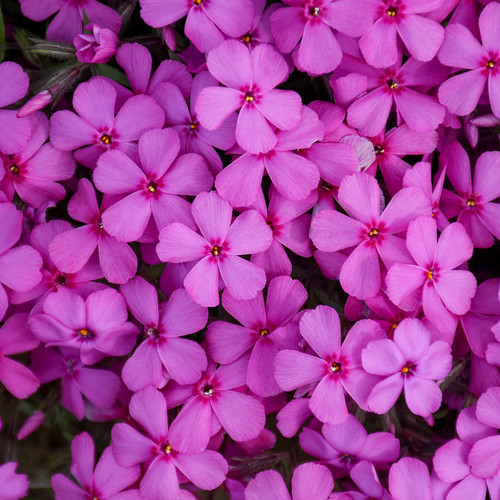
Phlox delivers big waves of color and sweet fragrance—perfect for sunny borders and cottage-style gardens. It’s an easy perennial that attracts butterflies and keeps your beds blooming for weeks.
Phlox is a genus of 67 species of perennial and annual plants in the family Polemoniaceae. We sell mostly perennial versions of the plant, which return year after year. The species plants are native to North America and can be found in the wild anywhere from New York to Iowa. The flowers can be blue, violet, pink, red, or white and are often fragrant. They can bloom in spring, summer or fall depending on the variety.
Phlox charms gardeners with its dense clusters of long-lasting flowers that attract bees, butterflies, and hummingbirds. The flowers come in a range of colors, from soft pastels to rich purples and reds, making this plant a staple for creating dynamic and colorful landscapes. The blooms are pleasantly scented, attracting pollinators and adding another layer of appeal. These small plants will grow anywhere between 6 to 28 inches tall.
Most gardeners grow Phlox in perennial gardens, cut flower gardens, and wildlife sanctuaries. Trailing varieties add elegance to hanging baskets and containers, while upright species serve as excellent focal points or supports for less sturdy plants. Phlox is also an ideal choice for mass plantings to stabilize slopes or add texture to foundation plantings. For wetland areas, it provides both beauty and ecological value, thriving in damp conditions where few plants can perform so effectively.
Phlox
Type
Scientific Name
Native
Bloom Time
Habit / Size
USDA Zones
Uses
Creeping / Moss phlox
Phlox subulata
Dry, rocky slopes of E.-C. USA
Mid-spring
Mat-forming ground-cover, semi-evergreen; 4-6 in H
3 – 9
Rock gardens, path edges, slopes, erosion control
Creeping phlox (shade-tolerant)
Phlox stolonifera
Appalachians (USA)
Early spring
Low, stoloniferous mats; 6-12 in H
5 – 9
Part-shade groundcover, woodland edges
Woodland phlox
Phlox divaricata
Eastern woodland margins
Mid-spring
Spreading clumps 8-15 in H
3 – 8
Shade gardens, under trees, naturalizing
Meadow / Wild sweet-William
Phlox maculata
Moist meadows E. USA
Early-mid summer
Upright clumps 2–3 ft H
4 – 8
Pollinator & cottage gardens
Tall / Garden / Summer phlox
Phlox paniculata
Eastern-C. USA
Mid-summer – early fall
Upright clumps 3–5 ft H
4 – 8
Borders, cutting gardens, butterfly gardens
Annual phlox
Phlox drummondii
Texas & Gulf Coast
Mid-spring – mid-summer (longer with dead-heading)
Bushy mounds 12–18 in H
Grown as annual in all zones
Bedding, containers, wildflower mixes
Phlox Care
Phlox should be planted in early spring in a sunny location with moist, well-draining soil. Space plants far enough apart to ensure good air circulation and minimize powdery mildew. Water newly planted Phlox weekly until established, watering at the root zone to keep foliage dry. Then, provide about an inch of water per week during the growing season. Apply a general-purpose slow-release fertilizer in late winter or early spring to promote growth and blooms.
Phlox does not require much pruning, but cutting back stems by half in early summer can encourage a bushier plant with more flower heads. After blooming, trimming the plant can promote a second bloom. For winter care, after the first frost, cut stems back to the soil line and apply a 2-inch layer of mulch to protect roots from freeze-thaw cycles. When growing Phlox in containers, use a large pot with drainage holes and a quality potting mix. Water potted plants regularly and allowing the soil to dry between waterings.
Phlox are typically early blooming plants that like at least 5 hours of direct sunlight each day. Pair other sun loving perennials, annuals and shrubs with phlox. Some of our favorite plants to grow with phlox are daylilies, bee balm, African daisies, yarrow, clematis, butterfly bushes and rose of sharon. If you choose summer or fall flowering plants, that will extend the blooming season of your garden.










 Growing Zones: 4 to 8